As our old pal Joseph Campbell reminds us, there’s really only one saga for a hero to fulfill, so it’s nice every once in a while to see that saga done with visual panache. The incredibly inventive 1982 (children’s?) sci-fi adventure flick Tron certainly has that. The little Netflix synopsis for the film namedrops Star Wars and German Expressionism, both worthwhile comparisons.
A friend who watched with me commented on the opening scenes’ problematic pacing, and indeed the movie seems to start mid-stride, not unlike Buckaroo Banzai, without any (perhaps needed) exposition. We’re conveyed back and forth between “real world” gamers and programmers, and hyper-stylized costumed characters who, we have to figure out mostly for ourselves, are anthropomorphized programs. Right away, we’re introduced to the concept that programs who acknowledge their “Users” are treated as a religious minority in the computer world, one of the film’s many nice touches, a sort of Phildickian flourish that also sets up the divine origin of one of the film’s two heroes, programmer extraordinaire Kevin Flynn (Jeff Bridges).
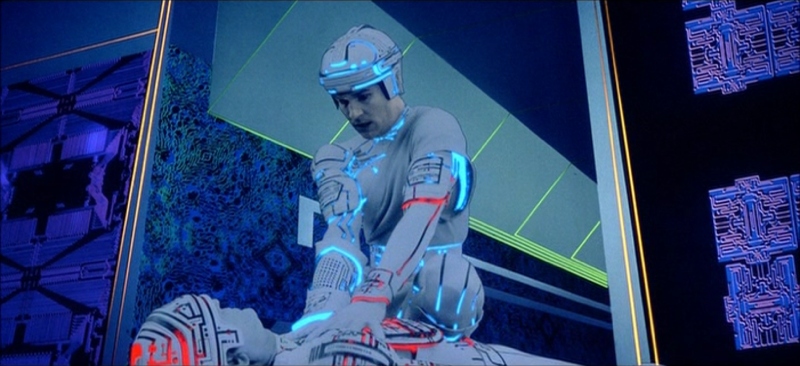
Flynn is a User—in fact, the creator of the many videogames that serve as fatal ordeals for the beleaguered programs—who is unwittingly sucked into the digital world by the sinister Master Control Program, voiced by David Warner, who also portrays the MCP’s sinister but out-of-his-league User, Ed Dillinger. The remarkably young Bridges plays Flynn as an easygoing guy, though his unprecedented powers and nigh-invulnerability are very un-Dude. Bridges may have unwittingly created the character of the hacker-slacker, who crops up these days in everything from Live Free or Die Hard to Dollhouse.
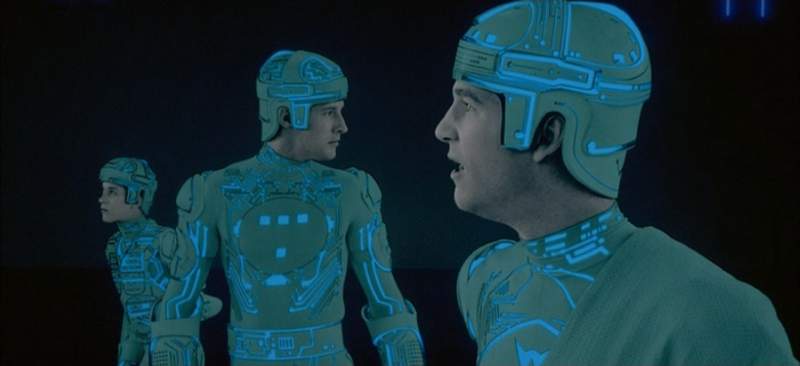
The film’s other hero is the titular Tron (Bruce Boxleitner), a charmingly driven but ultimately fairly boring warrior of faith. Actually a security program, Tron is purposed by his User, Alan, to undermine the MCP, who is tyrannizing and terrorizing all the other programs.
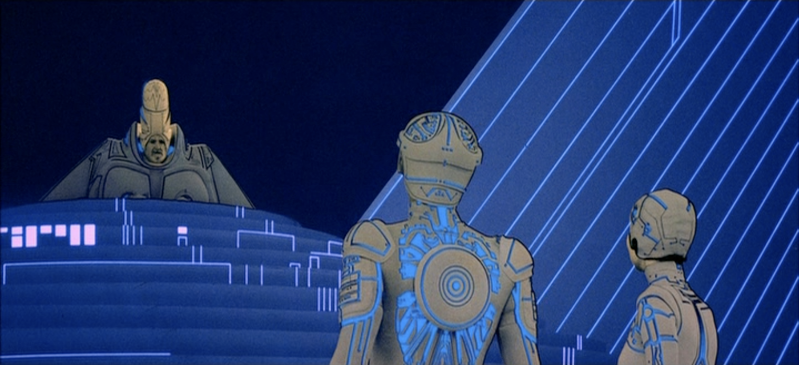
The visuals of the movie might at first seem dated, but they have something special going for them. They capture the disturbing unreality of early videogame graphics—even the characters’ faces are the wrong color, limited to the palette of old PC displays. This is where the German Expressionism comparison comes in, as much of the blocky computer-world scenery and painterly character design complement the strivings of a hot-blooded actual human trapped in a cold digital universe.
Surprisingly, Wendy Carlos’ soundtrack is a bit disappointing. I actually found myself thinking during the movie’s climax, “This electronic score ain’t got nothin’ on Clockwork Orange,” and was then shocked to see Carlos’ name in the credits.
Tron’s not a perfect movie—its clumsy framing is a bit bothersome—but it’s a pioneering and fun bit of fantasy, and a surprisingly influential film (cf. Sin City, The Matrix).
The upcoming Tron sequel, Tron Legacy, now looks all the more exciting. A story set in a virtual world is the rare film it makes perfect sense to update, since better special effects are practically part of the plot. The only concern is that too much attention to updating the quality of the graphics might neglect the stylized beauty, but the brief trailer released at San Diego Comic Con looks promising.
Saturday, September 5, 2009
REVIEW: Tron (1982, dir. Steven Lisberger)

Saturday, August 29, 2009
REVIEW: Funny Games (2007, dir. Michael Haneke)
Perhaps I was over-prepared for Funny Games. When Michael Haneke’s English-language remake of his own 1997 film first hit theaters, I read a review—I can’t recall where—that made me simultaneously terrified and curious to see it. It sounded like a fascinating formal experiment, but something I might not have the stomach to sit through. A post on Stacie Ponder’s Final Girl blog made me rethink this hesitation, since she indicated that the film did most of its damage off-screen. I became increasingly interested as I read more about Haneke’s body of work. Ultimately, Haneke’s original Austrian version sat on my Netflix queue for some time, until I came across the English version last night on HBO. I came in at about the halfway point, but I was riveted for the remainder of the movie and promptly TiVo’d the whole thing so I could watch the beginning of it right away.
There is something to be said for a movie that grabs you and shakes you even after its been relentlessly spoiled by multiple reviews and viewed out of sequence. The film details the brutal torment of a family at the hands of two young men, played by Michael Pitt and Brady Corbet. Michael Pitt’s character, variously referred to as Paul, Jerry and Butt-Head, repeatedly breaks the fourth wall and interfaces with the audience, who are as much his prisoners as the defenseless family. Naomi Watts and Tim Roth give moving performances as two people destroyed by tragedy, but as expected and feared, the real star of the movie is, well, the movie itself.
Pitt and Corbet are cartoon caricatures of serial killers, even going so far as to title themselves after the jaded perpetual observers Beavis and Butt-Head. They’re colder and less specifically satirical than American Psycho’s Patrick Bateman; they are actually most reminiscent of Mister Croup and Mister Vandemar, the archetypal bogeymen from Neil Gaiman’s fantasy novel Neverwhere. They are destroying people’s lives out of an adolescent impulse, as well as a repeatedly declared desire to “entertain.” Who, exactly, do they wish to entertain? That would be you, puny viewer. The movie plays constantly with the ethical problem of finding entertainment in the torture of innocent people.
The film’s heavy-handedness could be debated endlessly, but the film gets a couple things very right. For one, it’s scarier than a lot of horror films, favoring pacing over splatter. Long, tense shots with maybe one or two points of movement dominate the middle part of the film, and multiple acts of cruelty are synthesized through off-camera sounds of anguish. Also, it has a mightily unsettling opening sequence, where a cheerful, entirely un-ominous family car ride featuring a (funny?) game of Guess What Opera We’re Listening To is unceremoniously torn asunder by a maddening burst of shrieky music by John Zorn’s Naked City ensemble. Here's the scene:
It’s hard to imagine sitting through the original version of the film anytime soon, but now I’ve broken through to the world of Haneke, I’ll probably seek out Caché and 71 Fragments of a Chronology of Chance. Funny Games is a blistering style piece, whether or not you’re on board with its didactic element.
Image source: Mark O'Sullivan
